The M-layer register of scales and aspects
The M-layer uses compact digital objects to identify scales and aspects. Each aspect, scale, and reference has a unique identifier, which can be used to access more detailed information in a central register.
The register holds records of aspects, scales, and references (units or other types of reference), and provides support for conversions and casting of expressions to different scales and aspects.
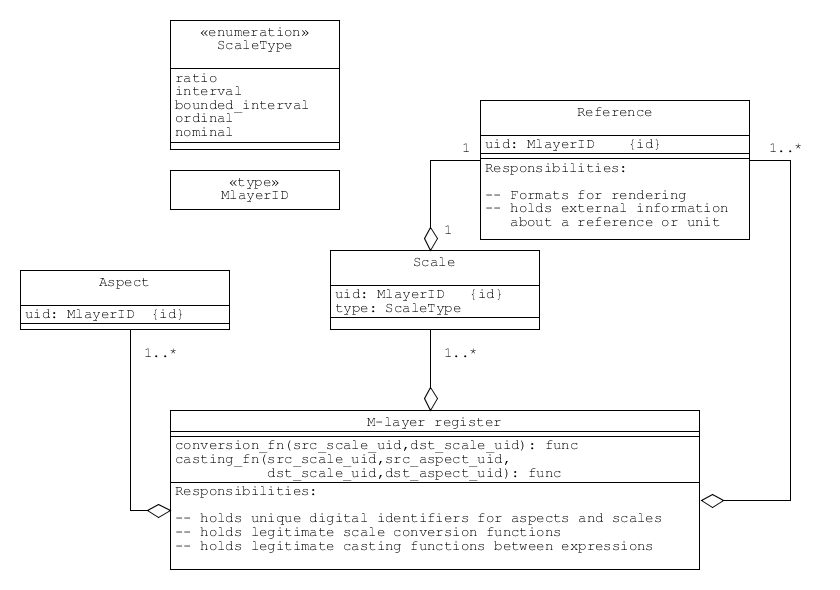
A UML class diagram showing the central register and its associations. The register supports scale conversion and casting from one expression to another by maintaining tables of legitimate conversions and casts, which are indexed by the unique scale and aspect identifiers.
Relationship between scales and references
An M-layer ‘scale’ simply forms an association between a reference and a particular scale type (see Scales).
In the M-layer, a ‘reference’ is a digital record for a unit of measure, or other measurement reference (e.g., a certified reference material). The record holds information about the reference (including external information), like formats for rendering the name or symbol. A reference record for a unit belonging to a unit system will include a reference to the system (in the M-layer) and the dimentional exponents of the unit in that system.
Expression conversion
An expression can be converted from one scale to another when an operation to do so has been registered.
Scale conversion is similar to conversion in traditional unit systems. However, the M-layer distinguishes between:
legitimate conversions for particular aspects; and
conversions that are only legitimate for a particular aspect.
An example of the first is conversion from metres to millimetres. An example of the second is the conversion of an expression of photon energy in electronvolts to terahertz.
Expression casting
A casting operation can change the aspect as well as the type of scale for an expression. Casting operations may substantially alter the mathematical structure of data. They are distinct from conversion operations, which apply an invariance transformation. For instance, a cast is required to change an expression of photon energy from terahertz to nanometres, because wavelength is inversely related to frequency (i.e., there is a change of variable from frequency to wavelength).